
Winchester adopted its Local Plan on 24 March 2026, fixing 687 homes a year and a 6.2 year land supply. What is allocated, and what the 2044 plan changes.
Winchester spent eight years writing a Local Plan and adopted it on 24 March 2026. That single date changes how every planning application in the district outside the South Downs National Park is now judged, because the council finally has an up to date plan and a five year housing land supply to defend it with. It also started a clock: work on the next Local Plan, running to 2044, formally began on 30 June 2026, and the housing numbers behind it are higher.
Here is what the adopted plan commits the district to, where the homes are meant to go, and the dates that matter for anyone who wants a say in the next one.
The plan that was adopted, and the numbers in it
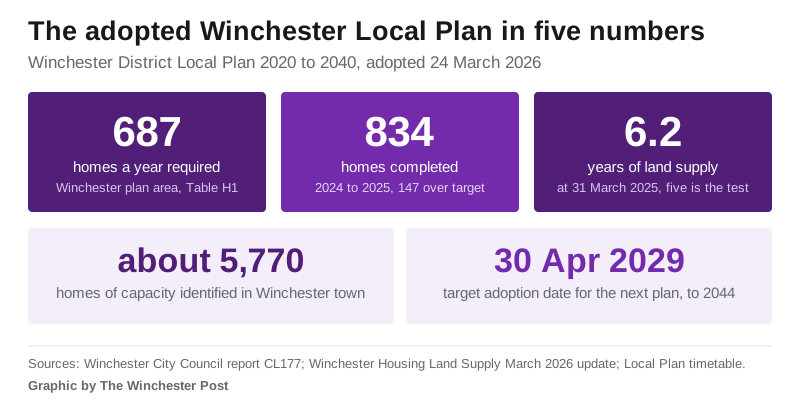
Winchester City Council adopted the Winchester District Local Plan 2020 to 2040 at a full Council meeting on Tuesday 24 March 2026. The independent Planning Inspector, R Barrett MRTPI IHBC, had confirmed on Wednesday 11 March that the plan, with its main modifications, was sound, legally compliant and ready for adoption (Winchester City Council).
The route there was long. The plan was submitted to the Secretary of State in November 2024, examination hearings ran between April and June 2025, and the proposed main modifications went out for public consultation between December 2025 and January 2026 (Council report CL177). Adoption swept away three older documents: the 2013 Joint Core Strategy, the Development Management and Site Allocations plan, and the Gypsy, Traveller and Travelling Showpeople document.
Two housing figures are in circulation and they are not the same thing. The council’s own adoption report records that “the Local Plan’s housing requirement at the time of the Local Plan examination was 707 dwellings per year”. Since adoption, the figure the council actually uses for land supply is the one in the adopted plan’s Table H1: 687 dwellings a year for the Winchester plan area (Winchester Housing Land Supply, March 2026 update). On top of the government’s Standard Method figure for the district’s own need, the plan also carries an “unmet need allowance” to help absorb demand from neighbouring areas under the duty to co-operate.
The land supply position is the practical prize. On the council’s March 2026 calculation, the Winchester plan area had 6.2 years of housing land supply at 31 March 2025, against an annual requirement of 711 once the buffer is applied. The district also over-delivered in 2024 to 2025, completing 834 homes against a requirement of 687.
Anything above five years of supply matters because it is the threshold at which the national “presumption in favour of sustainable development” stops working in a developer’s favour on appeal. Councillor Martin Tod put it plainly when the council set out its next steps: “we’re protected from unplanned development at the moment because we put a robust Local Plan in place this March” (Winchester City Council, 30 June 2026).
Where the homes are meant to go
The plan expects capacity for about 5,770 homes in Winchester town across the plan period, made up of completions, existing permissions, a windfall allowance and a set of named allocations. The allocations chapter sets them out site by site (Winchester District Local Plan, development allocations):
| Policy | Site | Homes |
|---|---|---|
| W1 | Barton Farm, Andover Road / Wellhouse Lane (carried forward) | 1,680 |
| W2 | Sir John Moore Barracks, Andover Road | 900 |
| W7 | Central Winchester Regeneration area | 300 |
| W8 | Station Approach area | 250 |
| W11 | University and hospital area (student, dwelling equivalents) | 200 |
| W4 | Courtenay Road | 100 |
| W10 | River Park (student, dwelling equivalents) | 100 |
| W3 | St Peter's Car Park | 30 |
| W9 | Bar End Depot | 30 |
Two of those dominate. Barton Farm, the Kings Barton development off Andover Road, already holds planning permission for 2,000 new homes and is carried forward from the previous plan with 1,680 still to come. Sir John Moore Barracks, further up the same road, is the big new one: the policy allocates it for 750 to 1,000 homes with a working assumption of about 900, and the council’s supporting text requires a park and ride scheme on the site with capacity for up to 850 vehicles.
Bushfield Camp, on the southern edge of the city, is allocated under Policy W5 as an employment-led mixed use scheme rather than housing. Beyond the city, the plan’s strategy leans on the market towns and larger villages and on the continuing build-out at North Whiteley, where 3,500 homes already have outline or full permission.
One caveat worth knowing: the plan covers the district outside the South Downs National Park. If your village sits inside the park boundary, the National Park Authority is your planning authority, not the city council, and a different local plan applies.
The next plan is already running, and the numbers are bigger
The adopted plan was examined under transitional arrangements. Because it was submitted before 12 March 2025 and its housing requirement meets less than 80 per cent of local housing need under the 2024 Standard Method, government rules force Winchester to start again quickly. The council’s own report is blunt that the national housing numbers “have now increased again which will need to be addressed in the next Local Plan to 2044”.
The council published its Notice of Intention to start plan-making on 30 June 2026 and has set out this timetable for the Local Plan to 2044 (Local Plan timetable):
- 18 September 2026: scoping consultation, 21 days, closing at 23:59 on 9 October 2026. This is the first chance to comment, and our report on the Local Plan 2044 consultation sets out what it does and does not ask.
- 30 October 2026: Gateway 1, the first government checkpoint.
- 19 March 2027: Regulation 18 consultation on content and evidence, six weeks.
- 4 January 2028: Gateway 2.
- 4 February 2028: Regulation 19 publication of the proposed plan, eight weeks. This is the last formal comment window before submission.
- 7 July 2028: Gateway 3.
- 30 October 2028: submission to the Secretary of State.
- 30 April 2029: adoption.
The whole thing is compressed into roughly 30 months from Gateway 1, which is the point of the government’s reformed plan-making system.
There is a complication, and it got worse in September 2026. On 30 June 2026 the council said it would start work on a plan for the current district boundary while at the same time asking government and its neighbours to back joint plan-making across a proposed “Mid Hampshire” geography with Test Valley, New Forest and East Hampshire. Councillor Jackie Porter said “a positively prepared Local Plan is of paramount importance to ensure development in our district continues to happen on a planned basis”, and Councillor Martin Tod argued that “the best way to keep protecting our area from unplanned speculative development is to protect the whole of Mid Hampshire”.
Then on 7 September 2026 the government withdrew its reorganisation decision for Hampshire pending a rapid review, so the Mid Hampshire boundary is no longer settled either. The council’s own timetable page now states that “the timetables for Local Government Reorganisation and the new Local Plan process are currently not consistent”. Treat every date above as provisional.
What the council does when someone builds without permission
Adoption is one half of planning control. Enforcement is the other, and Winchester used the strongest tool available to it this summer. On 5 June 2026 the High Court, King’s Bench Division, granted the city council an injunction over land north of Forest Road in Denmead, where caravans and mobile homes had been stationed and lived in without planning permission (Winchester City Council).
The order bans further caravans or residential accommodation on the land, bans residential use, bans connection to services such as septic tanks, and bans building and engineering works or importing materials unrelated to lawful agricultural use. It runs until 4 June 2028, and the defendants were ordered to pay £6,000 in costs. Councillor Jackie Porter said the council was “absolutely committed to protecting our district from unauthorised development and ensuring that development takes place in accordance with the law”.
How to follow planning in the district yourself
- Search live applications on the council’s Public Access portal at planningapps.winchester.gov.uk. The simple search works; the weekly and monthly list views on that instance were returning server errors when we checked on 9 August 2026, so search by address, postcode or reference instead.
- Start from the council’s planning pages at winchester.gov.uk/planning for how to comment and what weight your comments carry.
- Read the adopted plan at localplan.winchester.gov.uk. It is a single large PDF, and the allocations chapter is the part most people actually want.
- Join the mailing list for the Local Plan to 2044 if you want warning of the September 2026 consultation rather than finding out afterwards.
If you are weighing up a move rather than an objection, our guide to Winchester house prices sets out what homes in the district are actually selling for, and Winchester roadworks and travel covers the M3 junction 9 rebuild that will shape journeys here until 2027.
Sources
- Winchester City Council adopts Local Plan
- Council report CL177, Adoption of the Winchester District Local Plan 2040 and the preparation of the Local Plan 2044
- Winchester Housing Land Supply, March 2026 update
- Winchester District Local Plan, development allocations chapter
- Local Plan timetable for the Winchester District Local Plan 2026 to 2044
- City council to ask Government and neighbouring councils to support a collaborative way forward for Local Plan development
- City Council secures High Court injunction against unauthorised Denmead development
Have your say